
Austriae Tabula Historica-Demographica

Austrian Historical-Demographic Database
ATHiD is dedicated to creating a machine-readable aggregate database for Austrian historical demography. Based at the Vienna Institute of Demography (VID) of the Austrian Academy of Sciences (OeAW), it aims to uncover ‘unlifted data treasures’—tabulated population data from Austria’s past that are not only of historical interest, but also an important part of the nation’s cultural heritage.
The ATHiD project aims to preserve historical demographic macro-data on Austria in long-time series for the purpose of scientific research with statistical tools. For the time being, numerous tables in historical reports remain inaccessible in machine-readable formats, and therefore cannot be applied for modern statistical analysis and modelling. Moreover, the current territory of Austria differs significantly from the boundaries of past political entities. As a result, some existing data need to be recalculated at the local level (e.g., by municipalities) to align with Austria’s contemporary borders.
To address these issues, the project digitizes and recalibrates aggregated demographic macro-data at the population level, as well as for regions and localities, enabling analysis within both historical and modern territorial contexts. The data are provided in calculable formats such as Excel or CSV, accompanied by metadata. To this end, ATHiD employs advanced IT tools designed to optimize the digitization process and minimize manual keying.
This project primarily covers the period from the 15th century to the 1970s, prioritizing population size, births, deaths, as well as literacy. The focus will be on the Republic of Austria and/or the Alpine Lands of the Habsburg monarchy, and politico-administrative subdivisions thereof, if feasible, including geo references. Attention is given to maintaining the constancy of minor civil divisions. Various materials and sources are utilized as input data for the project.
ATHiD will enable new insights into demographic phenomena of the past. Scholars across various disciplines (e.g., history, demography, sociology) may find support for reporting and analyzing population trends (e.g., the 1st and the 2nd Demographic Transition), research in and teaching of historical and current demography, dealing with the causes and consequences of population change in the context of non-demographic phenomena of modernization, such as industrialization, urbanization, epidemiological transition, secularization, etc.
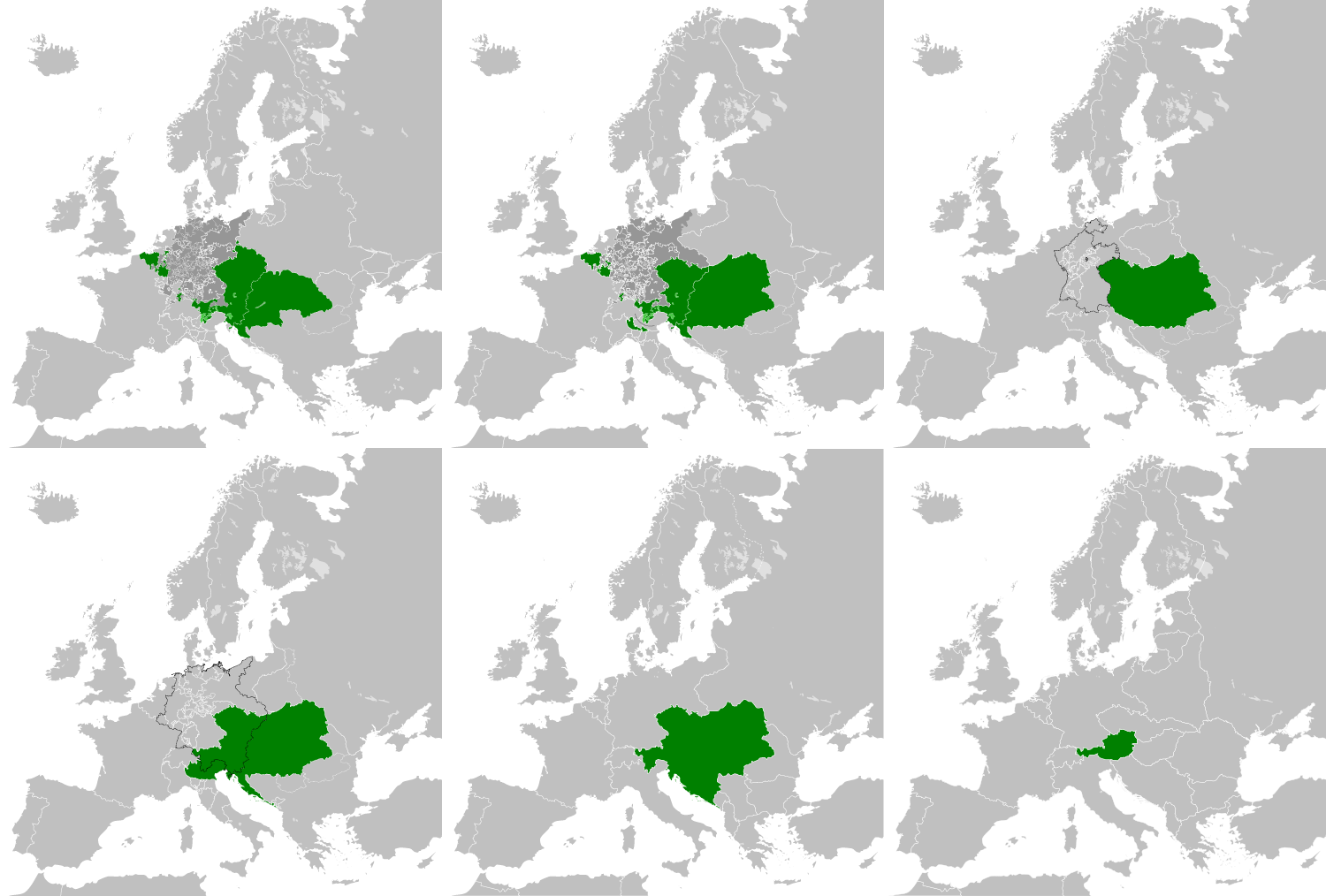
Map of Europe, Animation of the extent of the Habsburg Empire in 1714, 1789, 1812, 1815, 1914 and Austria from 1938 on in green – based on wikimedia svg files (see sources)
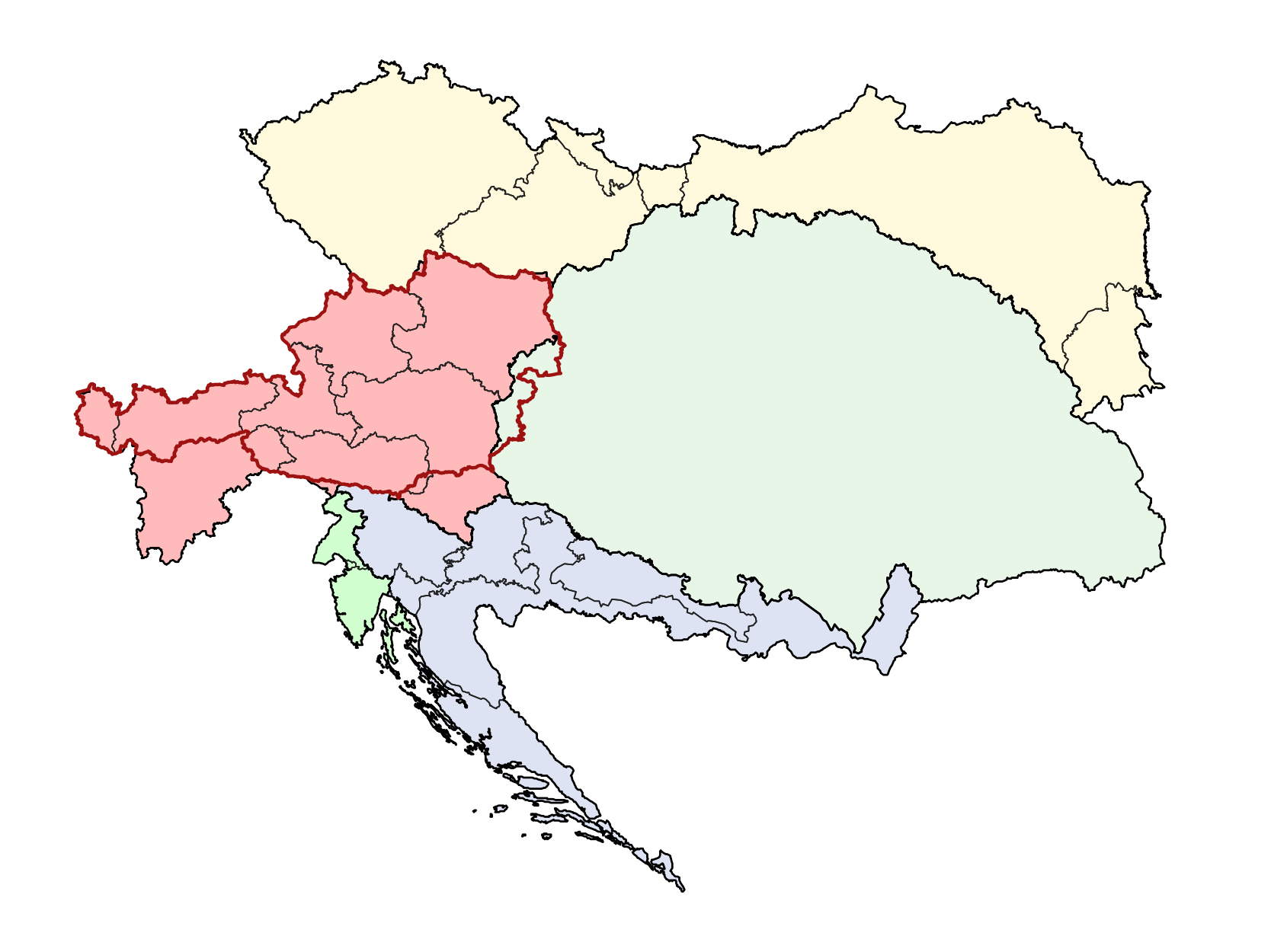
indicating modern day Austrian borders – based on geojson data from the HistoGis project and shapefiles from Statistics Austria (see sources)